

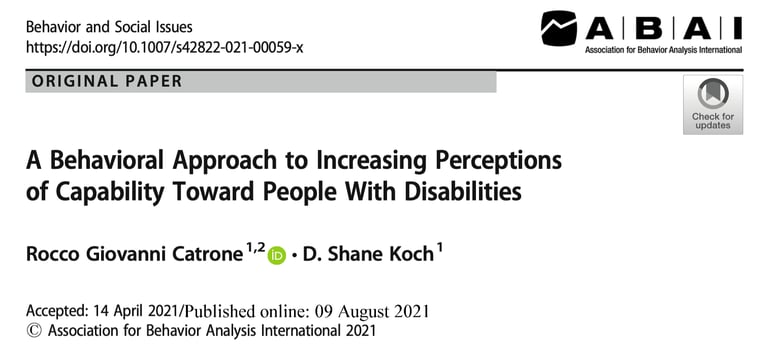
A Behavioral Approach to Increasing Perceptions of Capability Toward People With Disabilities
A review of how behavior analytic approaches using RFT can help reduce disability stigma.
RFTDISABILITY STIGMAPUBLICATION
2 min read
TL;DR
Read the Full Article by clicking this link: https://www.researchgate.net/publication/353789617_A_Behavioral_Approach_to_Increasing_Perceptions_of_Capability_Toward_People_With_Disabilities
The Issue: One billion people with disabilities face barriers in education, healthcare, and legal protection due to stigma and harmful automatic associations
The Approach: Researchers used Relational Frame Theory (RFT) to create a computer-based training that teaches new mental associations between people with disabilities and capability
The Results: Participants showed increased psychological flexibility, reduced stigmatizing thoughts, and higher perceptions of capability toward people with disabilities
The Innovation: First study to use behavioral science principles to directly address disability stigma, with potential applications in professional training and education
The Problem
One billion people worldwide live with some form of disability, yet they continue to face significant barriers stemming from stigma and misunderstanding. The researchers explain that from an early age, our communities teach us that to achieve life goals, you must be "capable." When people encounter someone whose behaviors or appearance differ from what's considered "typical," they may automatically categorize that person as "impaired" and therefore "incapable." These aren't conscious decisions—they're automatic associations built up over a lifetime of cultural messaging, leading people with disabilities to be avoided, underestimated, and excluded.
The Solution
Drawing on Relational Frame Theory (RFT)—a behavioral science framework explaining how we learn to relate concepts—researchers Rocco Giovanni Catrone and D. Shane Koch developed a computer-based training program to create new mental associations. Participants completed matching exercises that taught them to associate images of people with various visible disabilities with words denoting capability like "CAPABLE," "ABLE," and "ADEPT." Through immediate feedback during these exercises, participants learned new relationships between these concepts in a single session.
The Results
All five participants showed measurable change after completing the training: increased psychological flexibility, reduced stigma (four out of five participants), and higher capability perceptions across multiple life domains. Most importantly, these changed perceptions generalized to new individuals with disabilities that participants hadn't seen during training, suggesting genuine shifts in thinking rather than just memorized responses.
What Makes This Groundbreaking
This is the first study to use basic behavioral science principles to directly address stigma toward people with disabilities. While similar techniques had successfully reduced other forms of prejudice, this application to disability stigma opens new possibilities for brief, computer-based trainings that could be integrated into professional development for healthcare workers, educators, graduate training programs, and workplace diversity initiatives. The research demonstrates that stigma isn't fixed—it's learned, which means it can be systematically unlearned using evidence-based approaches.
About the Research: Based on "A Behavioral Approach to Increasing Perceptions of Capability Toward People With Disabilities" by Rocco Giovanni Catrone and D. Shane Koch, published in Behavior and Social Issues (2021).
BLEND LAB
© 2025. All rights reserved.