

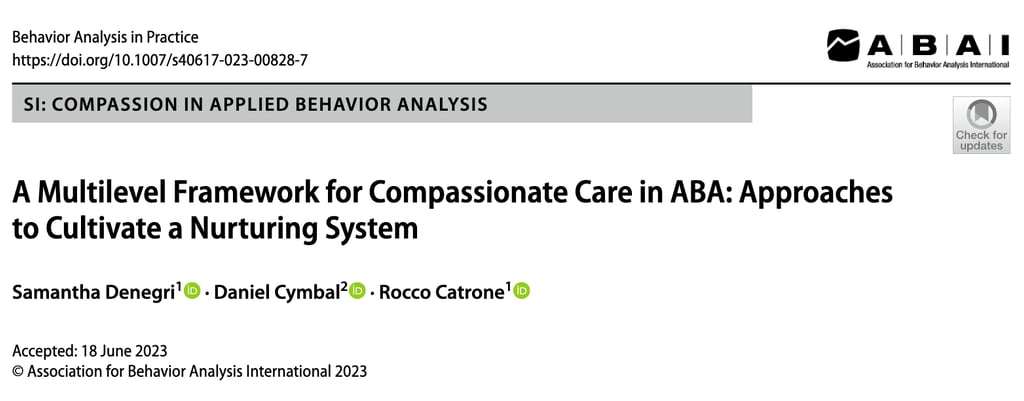
A Multilevel Framework for Compassionate Care in ABA: Approaches to Cultivate a Nurturing System
ABA organizations must systematically embed compassionate care across leadership, supervision, and therapy levels—not just train individual skills—to genuinely honor client experiences.
DISABILITY STIGMACLINICIAN SUPPORTCOMPASSIONATE CAREPUBLICATION
2 min read
TL;DR
Full article available here: https://www.researchgate.net/publication/372176568_A_Multilevel_Framework_for_Compassionate_Care_in_ABA_Approaches_to_Cultivate_a_Nurturing_System
ABA services need to prioritize how care is delivered, not just technical outcomes
Compassionate care requires organizational change at leadership, supervisor, and therapist levels
Training alone isn't enough—systems must support and sustain compassionate practices
Framework integrates OBM, ACT, and prosocial approaches to create nurturing environments
The Topic
Applied behavior analysis (ABA) has strong empirical support for treating autism and other developmental disabilities, yet consumer satisfaction remains problematic. Critics point to compliance-focused approaches that may inadvertently promote ableist practices and fail to honor client experiences. While ABA practitioners acknowledge the importance of therapeutic relationships and compassion, the field lacks a comprehensive framework for systematically cultivating these "soft skills" across entire organizations. This article addresses that gap by proposing a multilevel approach to embedding compassionate care throughout ABA service delivery systems.
The Approach
The authors present a three-tiered framework targeting organizational leaders, supervisors, and direct therapists. At the leadership level, they recommend behavior systems analysis (BSA) and prosocial methods to create organizational structures that value client experience and psychological flexibility. For supervisors, they emphasize performance management tools like the Performance Diagnostic Checklist-Human Services (PDC-HS) alongside training in relationship-building skills. At the therapist level, they advocate for Acceptance and Commitment Training (ACT) to address psychological inflexibility that may impede authentic empathy. The framework recognizes that training compassionate skills in isolation will fail without systemic support and aligned contingencies at all organizational levels.
The Verdict
The authors synthesize existing research showing that compassionate care improves patient satisfaction, treatment adherence, and clinical outcomes in medical fields, with emerging evidence in ABA contexts. Studies demonstrate that ACT-based interventions can enhance behavioral flexibility and work performance, while supervisor training in relationship skills shows promise (though maintenance and generalization remain understudied). The framework itself represents a conceptual contribution rather than empirical findings, integrating OBM, contextual behavioral science, and compassion research into a cohesive organizational model. Table 1 provides actionable steps for each organizational level, from policy changes to daily therapeutic practices.
Why This Is Important
This framework addresses legitimate criticisms of ABA while remaining conceptually systematic and true to behavioral principles. By recognizing that compassion requires more than individual therapist training—that it demands organizational design, performance management, and attention to verbal behavior and psychological flexibility—the authors offer ABA organizations a roadmap for meaningful cultural change. This matters because our field's effectiveness depends not only on technical proficiency but on honoring the dignity and lived experiences of autistic individuals and their families. Without systemic approaches to compassionate care, even well-intentioned training initiatives risk failure, perpetuating the disconnect between ABA's evidence base and consumer satisfaction.
Citation
Denegri, S., Cymbal, D., & Catrone, R. (2023). A multilevel framework for compassionate care in ABA: Approaches to cultivate a nurturing system. Behavior Analysis in Practice. https://doi.org/10.1007/s40617-023-00828-7
BLEND LAB
© 2025. All rights reserved.