

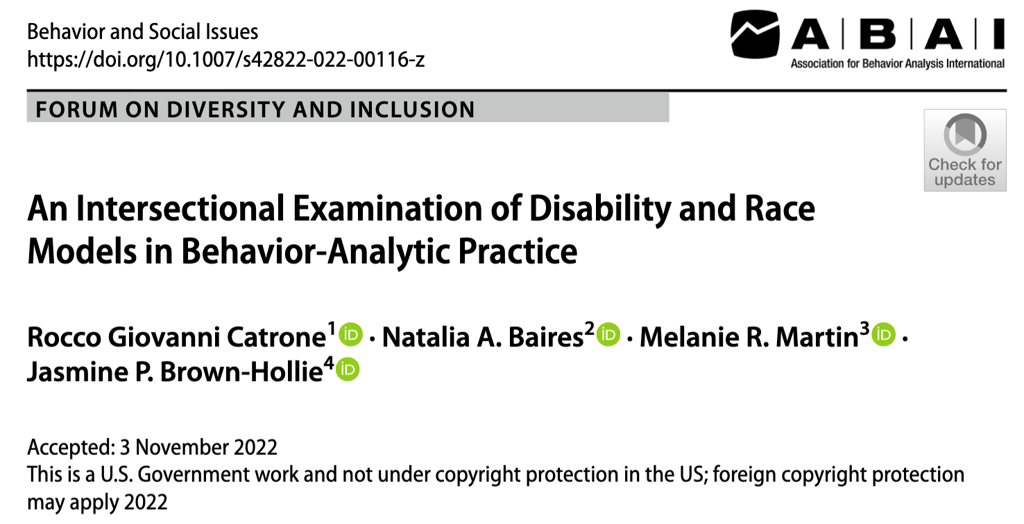
An Intersectional Examination of Disability and Race Models in Behavior-Analytic Practice
This paper applies Disability Critical Race Theory to behavior analysis, providing frameworks for addressing how racism and ableism intersect in practice.
DISABILITY STIGMAANTIRACISMCOMPASSIONATE CARECLINICIAN SUPPORTDISABILITY CRITICAL RACE THEORYPUBLICATION
4 min read
TL;DR
Read the Full Study: https://www.researchgate.net/publication/365681003_An_Intersectional_Examination_of_Disability_and_Race_Models_in_Behavior-Analytic_Practice
The Issue: Behavior analysts predominantly serve people with disabilities from diverse racial backgrounds, yet the field has not adequately examined how racism and ableism intersect to create compounded barriers
The Approach: Disability Critical Race Theory (DisCrit) provides a framework combining Critical Race Theory and disability studies to understand how race and disability interact in oppressive systems
Key Models Examined: The moral model (disability as divine plan), medical model (disability as impairment to fix), and social model (disability created by environmental barriers) each have implications for culturally responsive practice
The Innovation: First comprehensive examination applying DisCrit to behavior-analytic practice with actionable recommendations at organizational, provider, research, and education levels
The Problem
One billion people worldwide have disabilities, with Black/African American communities most likely to have a disability (14%), followed by non-Hispanic white (11%), Latino (8%), and Asian (5%) populations. As the U.S. becomes increasingly diverse—projected to be 29% Latino, 13.4% Black/African American, and 9% Asian/Pacific Islander by 2050—behavior analysts must address the intersection of race and disability in their practice. Yet the field has largely ignored this intersection. Black families of Autistic children report experiencing racism while navigating services: professionals make assumptions about their intelligence, single-parent status, insurance type (assuming Medicaid), and neighborhood safety. Latino families face similar barriers—language differences, rigid scheduling that conflicts with religious practices, and lack of flexibility for extended family involvement in care. These experiences reveal how ableism (discrimination against people with disabilities) and racism compound to create unique barriers. The problem is exacerbated when behavior analysts, 70% of whom identify as white, approach disability solely through a medical model lens—viewing disability as something to "fix" to make individuals "normal"—without considering how cultural values, intersecting identities, and systemic oppression shape the lived experiences of BIPOC individuals with disabilities.
The Approach
The authors propose Disability Critical Race Theory (DisCrit) as a framework for culturally responsive behavior-analytic practice. DisCrit combines Critical Race Theory with disability studies to examine how racism and ableism intersect and mutually reinforce each other. The solution begins with understanding three disability models: the moral model (viewing disability through religious/cultural beliefs), the medical model (disability as biological impairment requiring treatment), and the social model (disability created by societal barriers rather than individual impairment). Each model has practice implications—for example, Latino families who view their child's disability as part of God's plan (moral model) may reject deficit-focused approaches but respond to respectful collaboration that honors their beliefs. The authors then introduce DisCrit's seven tenets as actionable frameworks: focusing on how racism and ableism circulate in society, valuing multiple intersecting identities, highlighting social construction of race and disability, understanding legal/historical implications, privileging voices of marginalized groups, recognizing whiteness and ability as property, and requiring advocacy and resistance. For each tenet, specific recommendations are provided across four levels—organizational (developing anti-racist/anti-ableist policies, recruiting diverse staff), provider (respecting client language preferences, ensuring collaborative goal-setting), research (reporting demographic variables, including diverse participants), and education (incorporating critical theories in coursework, teaching self-advocacy).
What now?
Current research reveals significant disparities and concerning practices in behavior-analytic services for BIPOC families. Studies document that Black caregivers experience overt disrespect from professionals who minimize parental concerns, don't seek input on children's strengths, and even accuse caregivers of being untruthful about progress. Latino families report terminating or modifying ABA services because of inflexible scheduling, lack of consideration for extended family caregiving roles, and emphasis on parent participation that doesn't accommodate work schedules or cultural practices. The field's demographics reflect part of the problem: 86% of behavior analysts at master's and doctoral levels identify as white females, and children of color with disabilities experience both over-representation (Black and Latino children in specific learning disability categories) and under-representation (in autism categories) in special education. Qualitative research with Autistic adults who received ABA as children reveals experiences of being pressured to mask their Autistic behaviors, not being given agency to express desires, and feeling their natural behaviors were viewed as unfavorable. When behavior analysts operate from a purely medical model perspective—focused on making individuals "indistinguishable from peers" or "normal"—without considering cultural context or intersecting identities, they risk perpetuating both ableism and racism while violating bioethical principles of autonomy, nonmaleficence, and beneficence.
What Makes This Groundbreaking
This is the first paper to comprehensively apply Disability Critical Race Theory to behavior-analytic practice, providing a theoretical and practical roadmap for addressing intersectionality. While previous behavior-analytic literature addressed cultural responsiveness or disability separately, this work examines how race and disability interact to create unique experiences of marginalization that cannot be understood by examining either identity in isolation. The authors provide concrete, actionable recommendations across four levels of practice (organizational, provider, research, education) for each of DisCrit's seven tenets—creating a matrix of 28 specific implementation strategies. This practical approach moves beyond acknowledging that disparities exist to providing specific steps for change: how to recruit and retain diverse staff, how to respect linguistic diversity in service delivery, how to report demographics in research, how to privilege marginalized voices in decision-making, and how to teach these concepts in coursework. The paper also challenges fundamental assumptions in ABA practice—questioning whether goals focused on "normalization" or "indistinguishability from peers" serve clients or perpetuate ableist ideologies, and whether the field adequately considers who benefits from behavioral goals. By integrating person-first versus identity-first language debates, examining historical models of disability, and connecting to BACB ethical standards, the authors create a comprehensive framework that behavior analysts can immediately apply to promote equity, inclusion, and justice for the increasingly diverse populations they serve.
About the Research: Based on "An Intersectional Examination of Disability and Race Models in Behavior-Analytic Practice" by Rocco Giovanni Catrone, Natalia A. Baires, Melanie R. Martin, and Jasmine P. Brown-Hollie, published in Behavior and Social Issues (2022).
BLEND LAB
© 2025. All rights reserved.