

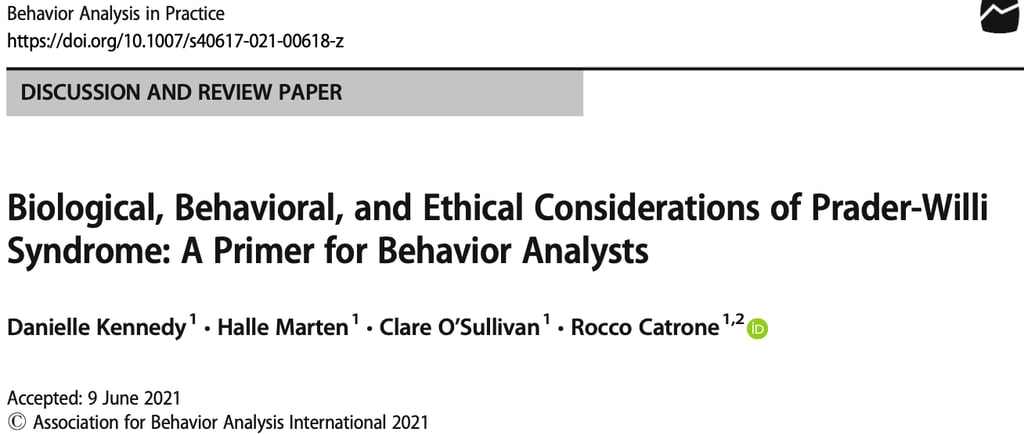
Biological, Behavioral, and Ethical Considerations of Prader-Willi Syndrome: A Primer for Behavior Analysts
This guide helps behavior analysts ethically treat Prader-Willi syndrome's insatiable hunger and compulsive behaviors through evidence-based interventions and interdisciplinary collaboration.
PWSCLINICIAN SUPPORTPUBLICATION
1/27/20263 min read
TL;DR
Read the Full Study: https://www.researchgate.net/publication/353523147_Biological_Behavioral_and_Ethical_Considerations_of_Prader-Willi_Syndrome_A_Primer_for_Behavior_Analysts
The Issue: Prader-Willi syndrome (PWS) is a rare genetic disorder affecting roughly 1 in 22,000-25,000 births, characterized by hyperphagia (insatiable appetite), hypotonia (low muscle tone), intellectual disabilities, and food-related compulsions
The Approach: Applied behavior analysis (ABA) offers evidence-based interventions for skill acquisition and reducing problem behaviors, but requires careful ethical consideration and interdisciplinary collaboration
Key Interventions: Differential reinforcement, token economies, and stimulus control procedures show promise for addressing food-stealing and self-injurious behaviors without relying solely on punishment
The Innovation: This primer provides behavior analysts with biological context, ethical frameworks, and practical strategies for providing effective, person-centered care to individuals with PWS
The Topic
Prader-Willi syndrome presents unique challenges stemming from both biological and behavioral factors. The condition is caused by genetic abnormalities affecting chromosome 15, leading to hypothalamic irregularities that impact hunger regulation, muscle tone, growth, and temperature sensitivity. The most socially significant consequence is hyperphagia—an insatiable appetite that can lead to dangerous overeating, food stealing, and obesity-related health complications including Type II diabetes. Additionally, individuals with PWS commonly experience hypotonia (making physical activity difficult), skin-picking behaviors, insistence on routines, and mild to moderate intellectual disabilities. About 25% also have comorbid autism spectrum disorder. These interconnected biological and behavioral factors create complex care needs that require coordinated support from medical professionals, behavioral practitioners, families, and educators.
The Approach
Applied behavior analysis offers evidence-based approaches to address the behavioral challenges of PWS, but success requires understanding the biological underpinnings and collaborating across disciplines. Effective interventions include differential reinforcement procedures (rewarding appropriate food-related behaviors), token economy systems (teaching delayed gratification around food access), and stimulus discrimination training (helping individuals distinguish between permitted and prohibited foods). Researchers Kennedy, Marten, O'Sullivan, and Catrone emphasize that while restrictive approaches like locking up food may provide short-term safety, they're not sustainable long-term solutions and raise ethical concerns about autonomy. Instead, behavioral practitioners should work alongside physicians (who may prescribe growth hormone therapy), dieticians (for meal planning), occupational therapists (for physical skill development), and families to create comprehensive, person-centered treatment plans that respect the individual's dignity while addressing safety concerns.
The Results
Research demonstrates that behavioral interventions can successfully reduce problem behaviors in individuals with PWS without relying primarily on punishment. Studies show that differential reinforcement of other behavior (DRO) significantly decreased food-stealing when implemented with progressive interval schedules. Token economy systems combined with response blocking successfully reduced food-stealing in children with PWS, with effects generalizing to home settings during family meals. For self-injurious behaviors like skin picking—often maintained by automatic reinforcement—functional analyses help identify appropriate intervention strategies, with research suggesting that reinforcement-based procedures are as effective as punishment procedures. However, the authors note significant limitations in current research, including small sample sizes, lack of diverse demographics, insufficient longitudinal studies, and limited focus on adult populations or skill-building areas like socialization, self-advocacy, and daily living skills.
What Makes This Important
This article is the first comprehensive primer specifically designed to help behavior analysts navigate the complex ethical and clinical considerations of working with individuals with PWS. Unlike previous literature that focused primarily on medical interventions, this work bridges biological understanding with behavioral practice, providing concrete guidance on ethical service delivery according to BACB standards. The authors emphasize critical ethical considerations often overlooked in PWS treatment: ensuring interventions don't unnecessarily restrict autonomy, collaborating with medical teams to monitor how hormone therapy affects behavior, prioritizing reinforcement over punishment, and involving individuals with PWS in treatment decisions. The article also provides practical resources, including a comprehensive table of evidence-based interventions for specific behaviors and a list of support organizations. Most importantly, it challenges practitioners to move beyond simply managing problem behaviors toward developing comprehensive skill-building programs that enhance quality of life, promote independence, and respect the individual's right to dignity and self-determination.
About the Research: Based on "Biological, Behavioral, and Ethical Considerations of Prader-Willi Syndrome: A Primer for Behavior Analysts" by Danielle Kennedy, Halle Marten, Clare O'Sullivan, and Rocco Catrone, published in Behavior Analysis in Practice (2022).
BLEND LAB
© 2025. All rights reserved.