

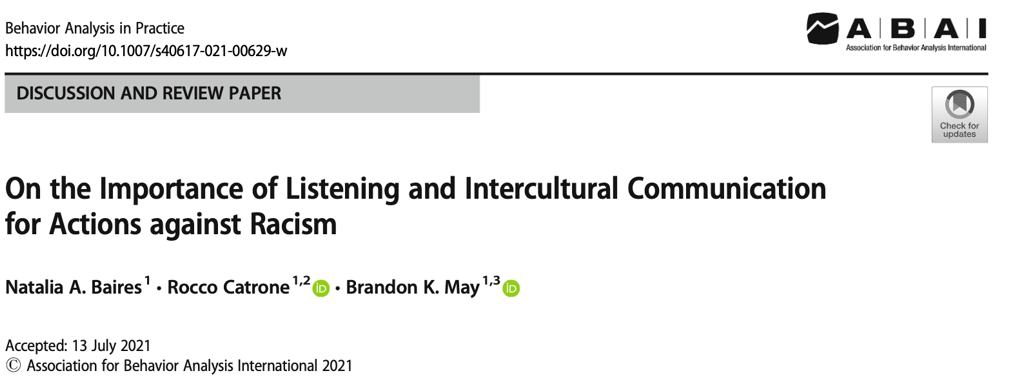
On the Importance of Listening and Intercultural Communication for Actions against Racism
This behavioral analysis shows effective listening requires mediating concrete anti-racist action, not just hearing words, to combat systemic racism through intercultural communication.
CLINICIAN SUPPORTANTIRACISMINTERCULTURAL LISTENINGPUBLICATION
1/27/20263 min read
TL;DR
Read the Full Study: https://www.researchgate.net/publication/354620202_On_the_Importance_of_Listening_and_Intercultural_Communication_for_Actions_against_Racism
The Issue: Despite claims of a "postracial" society, Black, Indigenous, and People of Color (BIPoC) continue facing systemic racism, yet their calls for change are often heard but not listened to by non-BIPoC
The Approach: Effective intercultural communication (ICC) requires listeners to functionally mediate reinforcement for speakers—meaning taking concrete action, not just acknowledging words
Key Barriers: Language differences, nonvocal/nonverbal misunderstandings, ethnocentrism, stereotypes, and discrimination create obstacles to effective ICC between cultural groups
The Innovation: This behavioral analysis reframes listening as an active behavior requiring specific skills—patience, avoiding multitasking, limiting interjections, and welcoming difficult conversations—to combat racism through precise reinforcement
The Problem
The notion of a "postracial" America—popularized after President Obama's election—is a dangerous myth. Despite centuries of activism by BIPoC advocating for police reform, educational equity, healthcare access, and legal protections, systemic racism persists. The murders of Trayvon Martin, Sandra Bland, Breonna Taylor, George Floyd, and countless others demonstrate that racial equality remains unrealized. From a behavioral perspective, the problem lies in ineffective intercultural communication: non-BIPoC may hear what BIPoC are saying, but they fail to listen—that is, they fail to mediate the reinforcement (meaningful action and systemic change) that BIPoC speakers have clearly specified. When communication between cultural groups breaks down due to barriers like language differences, nonvocal misunderstandings, ethnocentrism, and prejudice, BIPoC experience repeated extinction and punishment for their advocacy efforts, creating physiological and psychological harm while allowing oppressive systems to continue unchecked.
The Approach
Effective intercultural communication requires redefining the listener's role from a passive receiver of information to an active mediator of reinforcement. Drawing on Skinner's analysis of verbal behavior, authors Baires, Catrone, and May propose that true listening means taking concrete action that produces the outcomes speakers have requested. The solution involves developing specific listener behaviors: practicing patience during language discrepancies by using direct language and asking clarifying questions without microaggressions; limiting multitasking and private verbal behavior to stay present with the speaker's message; refraining from interjecting personal experiences that shift attention away from the speaker; and most critically, welcoming difficult conversations about racism even when uncomfortable. This means non-BIPoC must engage in conversations with people holding opposing views, acknowledge their own implicit biases, and stop avoiding topics about race that their verbal communities may have punished. The goal is for listeners to functionally—not just topographically—mediate reinforcement by taking actions that produce equity, inclusion, and justice.
The Verdict
Research demonstrates that ineffective intercultural communication creates measurable harm. Studies show that white individuals experience cardiovascular stress when interacting with stigmatized groups, while BIPoC experience increased psychological and physiological stress following experiences of racism. Most significantly, BIPoC face additional burden when expected to be the sole educators for non-BIPoC peers, and their repeated advocacy is met with extinction (being ignored) rather than reinforcement (meaningful change). The behavioral literature reveals that barriers like nonvocal differences (gestures meaning different things across cultures), language discrepancies, ethnocentrism (believing one's culture is superior), and discrimination all interfere with precise reinforcement. When listeners fail to mediate appropriate consequences—such as when organizations release diversity statements without changing racist practices—they provide only topographical, not functional, reinforcement. This perpetuates the cycle where BIPoC continue advocating without contacting the reinforcement (systemic change) they've clearly specified for centuries.
What Makes This Important
This article is the first to apply Skinnerian verbal behavior analysis specifically to intercultural communication in the context of racism, providing behavior analysts with a functional framework for anti-racist action. Rather than treating listening as a passive cognitive process of "understanding," the authors operationalize it as an observable behavior with measurable components: the listener must mediate precise reinforcement for the speaker's verbal behavior through concrete actions. This reframing has profound implications—it means that "knowing about" or "understanding" racism is insufficient unless it produces behavior change that counters oppression. The article challenges behavior analysts to examine whether their responses to BIPoC truly function as reinforcement (producing equity and justice) or merely appear topographically correct (diversity statements, nodding in agreement). By identifying specific listener repertoires that need development and calling for empirical research on ICC using behavior-analytic methodologies, this work provides practitioners and researchers with an actionable roadmap for using behavioral science to dismantle systemic racism through effective, functionally-defined communication.
About the Research: Based on "On the Importance of Listening and Intercultural Communication for Actions against Racism" by Natalia A. Baires, Rocco Catrone, and Brandon K. May, published in Behavior Analysis in Practice (2022).
BLEND LAB
© 2025. All rights reserved.