

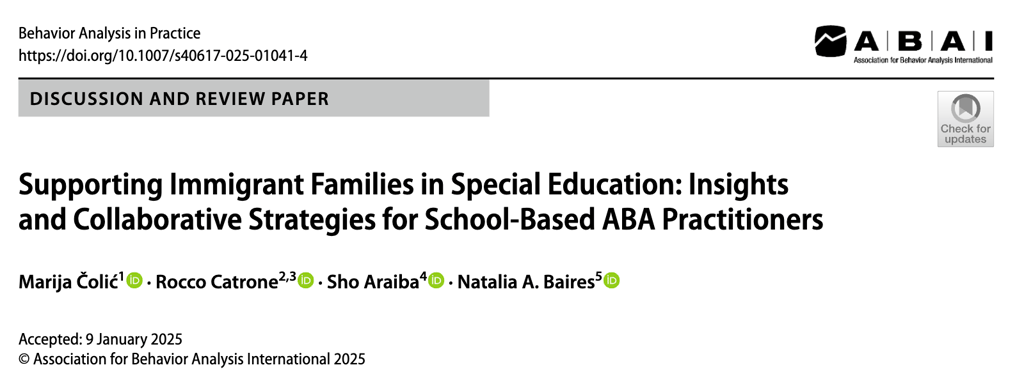
Supporting Immigrant Families in Special Education: Insights and Collaborative Strategies for School-Based ABA Practitioners
This paper adapts a partnership framework to help school-based ABA practitioners support immigrant families of neurodivergent children through culturally responsive practice.
DISABILITY STIGMACLINICIAN SUPPORTIMMIGRANT INCLUSIONPUBLICATION
2 min read
TL;DR
Full paper available here: Supporting Immigrant Families in Special Education
Immigrant families of neurodivergent children face significant barriers accessing special education services in the U.S., including language difficulties, cultural differences, and lack of knowledge about the educational system
This paper adapts Epstein's school-family-community partnership framework specifically for ABA practitioners working with immigrant families
Six types of involvement are outlined: parenting, communicating, volunteering, learning at home, decision-making, and collaborating with community
Key recommendations include using professional interpreters, avoiding jargon, understanding cultural values around education and disability, and building trust through consistent communication
The Topic
Approximately 10.3% of U.S. public school students are emergent bilingual/multilingual, with 16.1% of these students also having disabilities. Despite these numbers, immigrant families of neurodivergent children encounter substantial obstacles navigating the special education system—from understanding what an IEP is to accessing interpreter services to feeling empowered to advocate for their children. School-based ABA practitioners, as members of educational teams, have an ethical responsibility to support these families, yet little guidance exists on how to do so effectively within the school context.
The Approach
The authors conducted a qualitative review of studies examining immigrant families' experiences with special education services in the U.S., identifying barriers to accessing services and caregiver involvement. They then adapted Epstein's widely-used collaborative framework—which outlines six types of family involvement (parenting, communicating, volunteering, learning at home, decision-making, and collaborating with community)—to provide specific, actionable recommendations for school-based ABA practitioners. Each type of involvement was examined through the lens of immigrant families' unique needs, with practical strategies offered for building rapport, overcoming language barriers, respecting cultural values, and fostering genuine partnerships.
The Verdict
The adapted framework provides school-based ABA practitioners with concrete strategies across all six involvement types. For parenting, practitioners should assess family values around education and disability, use culturally informed functional assessments, and understand how acculturation stress affects student behavior. For communicating, recommendations include creating communication plans in families' preferred languages, simplifying language, learning basic words in the family's native language, and working effectively with interpreters. The framework emphasizes that not all recommendations will apply to every practitioner due to varying roles and school policies, but provides a comprehensive starting point for culturally responsive practice.
Why This Is Important
This work addresses a critical gap in ABA practice by acknowledging that immigrant families face unique, systemic barriers that go beyond typical parent training approaches. The paper makes clear that "limited knowledge" is not a family deficit but an environmental failure—lack of resources in native languages, absence of bilingual professionals, and insufficient systemic support. By providing a structured framework grounded in both special education research and ABA ethics, this paper equips practitioners to move beyond surface-level cultural awareness toward meaningful advocacy and partnership. As the ABA field continues to grow in schools, this framework offers a path toward more inclusive, equitable services that honor the strengths and cultures of immigrant families while supporting their neurodivergent children's success.
Citation:
Čolić, M., Catrone, R., Araiba, S., & Baires, N. A. (2025). Supporting immigrant families in special education: Insights and collaborative strategies for school-based ABA practitioners. Behavior Analysis in Practice, 18, 1199–1223. https://doi.org/10.1007/s40617-025-01041-4
BLEND LAB
© 2025. All rights reserved.